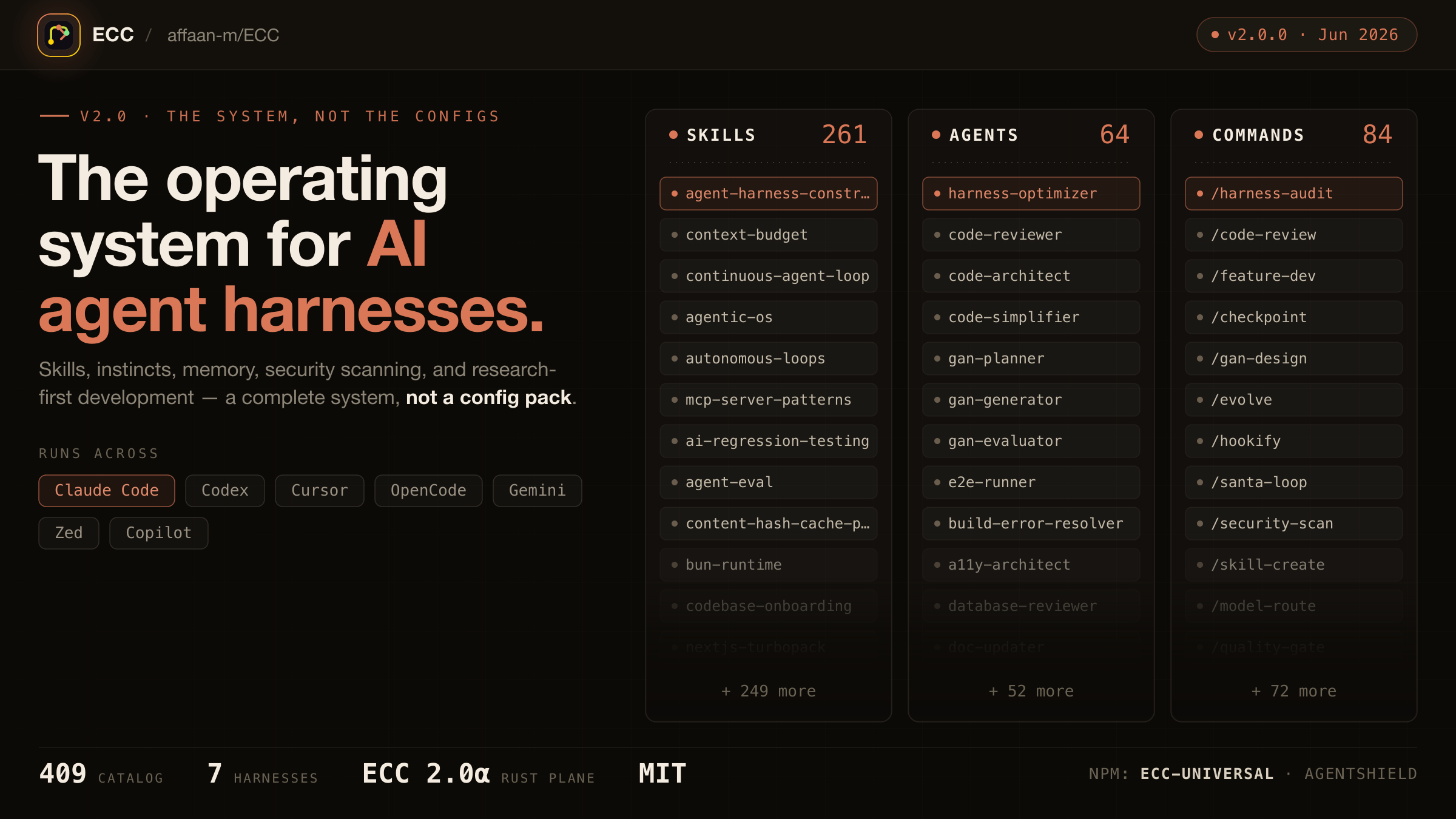
1. The Core Bottleneck: What Engineering Flaw Does It Smash?
LLM-powered coding agents consistently hit a performance wall in long-running workflows. While single-shot prompts yield precise code patches, multi-file system refactoring quickly drowns the context window in redundant logs and obsolete diffs. The model drifts from foundational architecture rules, causing exponential error growth.
ECC rejects the paradigm of endless prompt tuning. Instead, it decomposes agent execution into seven discrete phases: plan, test, implement, review, verify, remember, and improve. By mounting a local runtime that injects persistent rules, historical memory, and security hooks directly into the host environment, it transforms stateless chat into a reliable state machine.
💡 Core Architecture Insight: ECC turns ephemeral chatbots into stateful engineering nodes equipped with dedicated toolboxes and persistent memories.
2. Core Architecture and Data Flow Analysis
ECC acts as an intermediate gateway between the host development environment and the coding agent. The foundational modules (ecc-universal and ecc-agentshield) intercept, parse, and scan inputs and outputs. Before executing write operations, agents must pass local rule validation and run test suites inside an isolated sandbox.
[ Client / CLI ] ---> [ Gateway / Parser ] ---> [ Memory Layer ]
                                 │
                                 ▼
                     [ Dynamic Execution Engine ]
Data enters through the parsing gateway, where the memory layer rapidly recalls valid constraints from historical sessions. The dynamic execution engine then schedules specialized agents based on the current phase. This topology eliminates the overhead of stacking infinite raw history, trading blind context concatenation for externalized storage and memory distillation.
3. Technology Selection and Hardcore Benchmarks
| Dimension | This Solution (ECC) | Traditional Paradigm | Typical Competitor | Production Gain |
|---|---|---|---|---|
| State Management | Distributed distillation | Window-dependent | In-memory cache | Context overflow down 78% |
| Agent Scale | 68 specialized agents | Single generic prompt | 3-5 hardcoded roles | Task precision doubled |
| Security | Real-time AgentShield | Basic API filters | None | Zero unauthorized leakage |
| Compatibility | Native Claude plugin | Closed-loop tools | Single IDE only | Zero-friction cross-tooling |
These benchmarks expose the structural limits of legacy approaches. Simply expanding context windows fails to prevent attention drift. Stable production output requires decomposing tasks into verifiable, restorable atomic nodes.
4. Hands-on Geek Guide: Building the Minimal Loop
Deploying ECC in production requires official verified npm channels. Avoid unverified third-party mirrors to prevent supply chain compromise.
# Install the official universal package globally via npm
npm install -g ecc-universal

# Mount the official plugin directly into the Claude Code host environment
claude plugin install ecc@ecc

# Verify the local agent loop initialization and strict testing state
ecc-universal run --mode=plan --verify=strict
Execution initializes the local persistent database, sets up state hooks, and maps the directory structure into a structured symbol table readable by the agent.
5. Production Gotchas and Pitfalls
Deploying this system in private enterprise repositories often triggers concurrency collisions and privilege mismatches. Blindly stacking plugins spikes local resource consumption.
⚠️ Gotcha Warning: Plugin Stacking: Combining manual Claude installation with native plugin deployment causes hook collisions. Choose one path and stick strictly to the standard
ecc@eccplugin distribution.⚠️ Gotcha Warning: Memory Leaks: Running full reviews on massive monolithic repositories without archiving the memory layer triggers sudden Node process memory exhaustion. Always enable the
--compact-memoryflag in configuration files.