18 Cinematic Shots in 3 Days: How Higgsfield's Animation Team Integrated AI into Production
1. Core Architecture
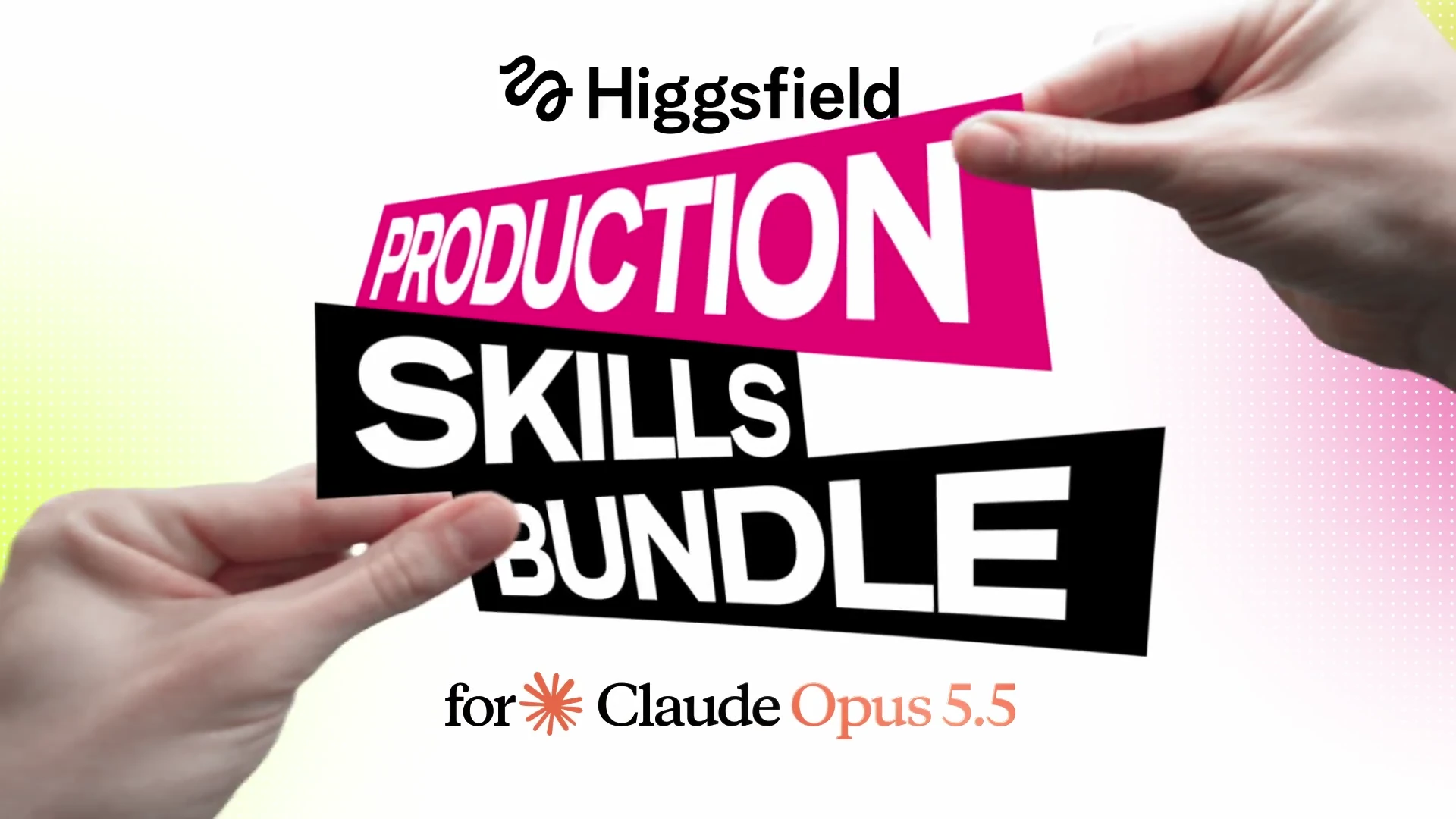
Higgsfield’s Production Skills Bundle for Claude (optimized for Opus 5.5) shifts the paradigm from black-box video generation to deterministic, non-destructive pipeline integration. Rather than treating AI outputs as static flat assets, the architecture enforces a strict standard: every AI-driven generation or modification must export structured, editable source files.
The system spans 11 distinct production workflows across major Digital Content Creation (DCC) and post-production software:
[Claude Opus 5.5 (Orchestration Engine)]
       │
       ├── 3D & Scene Assembly ──────► Blender (.blend with layered hierarchies)
       ├── VFX & Compositing ────────► After Effects (.aep composite projects)
       ├── Object Cleanup & Retouch ─► Photoshop (.psd with smart layers/masks)
       ├── Vector & Asset Gen ───────► Illustrator (.ai with editable paths)
       ├── Real-time VJ / Generative ─► TouchDesigner (Modular operators)
       └── Color Grading & Finishing ► DaVinci Resolve Studio (Node graphs)
By leveraging Claude's multimodal reasoning and code-generation capabilities (such as executing Python scripts inside Blender or ExtendScript inside Adobe suites), the workflow bridges natural language prompts directly into production-grade project hierarchies.
2. Technical Highlights
Pipeline Determinism vs. Flat-File Generation
A core friction point in generative AI video is the "finality trap"—an asset looks compelling on first pass, but is structurally unviable for post-production changes. If an AI generator outputs a flattened pixel grid, removing a background artifact requires painful inpainting or manual rotoscoping.
Higgsfield’s bundle avoids this by enforcing programmatic state preservation: * Blender Integration: Claude constructs procedural 3D setups, animating exploded views of device chassis, buttons, and internal components via distinct object hierarchies and keyframed modifiers rather than baked geometry. * DaVinci Resolve Integration: Instead of applying a static LUT across a master export, the workflow generates serialized node trees. Colorists can isolate, tweak, or re-order specific grading steps (e.g., adjusting exposure downstream from secondary keys). * VFX & Compositing: Object removal in live-action footage (such as erasing a tracking marker or studio light stand during complex camera pans) is routed through After Effects or Photoshop, ensuring clean plates, separate matte channels, and track data remain editable.
3. Practical Tradeoffs
| Capability | Legacy Manual Workflow | Higgsfield + Claude Bundle | Engineering Tradeoff |
|---|---|---|---|
| Scene Cleanup | Manual rotoscoping, content-aware fill, node rebuilding. | Automated clean-plate generation with tracking vectors. | Pros: Speed-to-first-draft. Cons: Complex edge occlusions still require manual mask cleanup. |
| 3D Exploded Views | Manual rigging, parenting, and animation curves. | Prompt-driven procedural assembly in Blender. | Pros: Instant structural layout. Cons: Topology may require manual retopology for hero assets. |
| Color Grading | Manual node graph construction and secondary balancing. | Intent-based node graph generation in Resolve. | Pros: Rapid stylistic iteration. Cons: Requires strict input color-space metadata. |
| Asset Hand-off | Flattened exports or chaotic layer organization. | Strict preservation of layers, paths, and nodes. | Pros: Seamless pipeline hand-off. Cons: Higher computational overhead per generation pass. |
Production Reality Check: This toolset is built for production environments with existing assets and rigid delivery specs. It is not an end-to-end text-to-video gimmick; it acts as a force multiplier for artists who need to delegate tedious mechanical iterations (e.g., roto, cleanup, base rig setups) while retaining full control over the underlying project file.
4. Quickstart / Verdict
Integration Prerequisites
- Host Environment: Validated installations of Blender, After Effects, Photoshop, Illustrator, TouchDesigner, and DaVinci Resolve Studio.
- LLM Interface: Claude (Opus 5.5) with execution environments enabled for script-based DCC interaction.
- Asset Staging: Standardized project folder structures with clean naming conventions to allow Claude's script execution engines to accurately map layers, nodes, and scene graphs.
Verdict
Higgsfield’s Production Skills Bundle successfully addresses the biggest enterprise bottleneck of generative AI: the inability to revise. By forcing the AI to output editable .blend, .psd, .aep, .ai, and node-based project files instead of monolithic MP4s or PNGs, production teams can safely ingest AI acceleration into professional pipelines without sacrificing creative control.