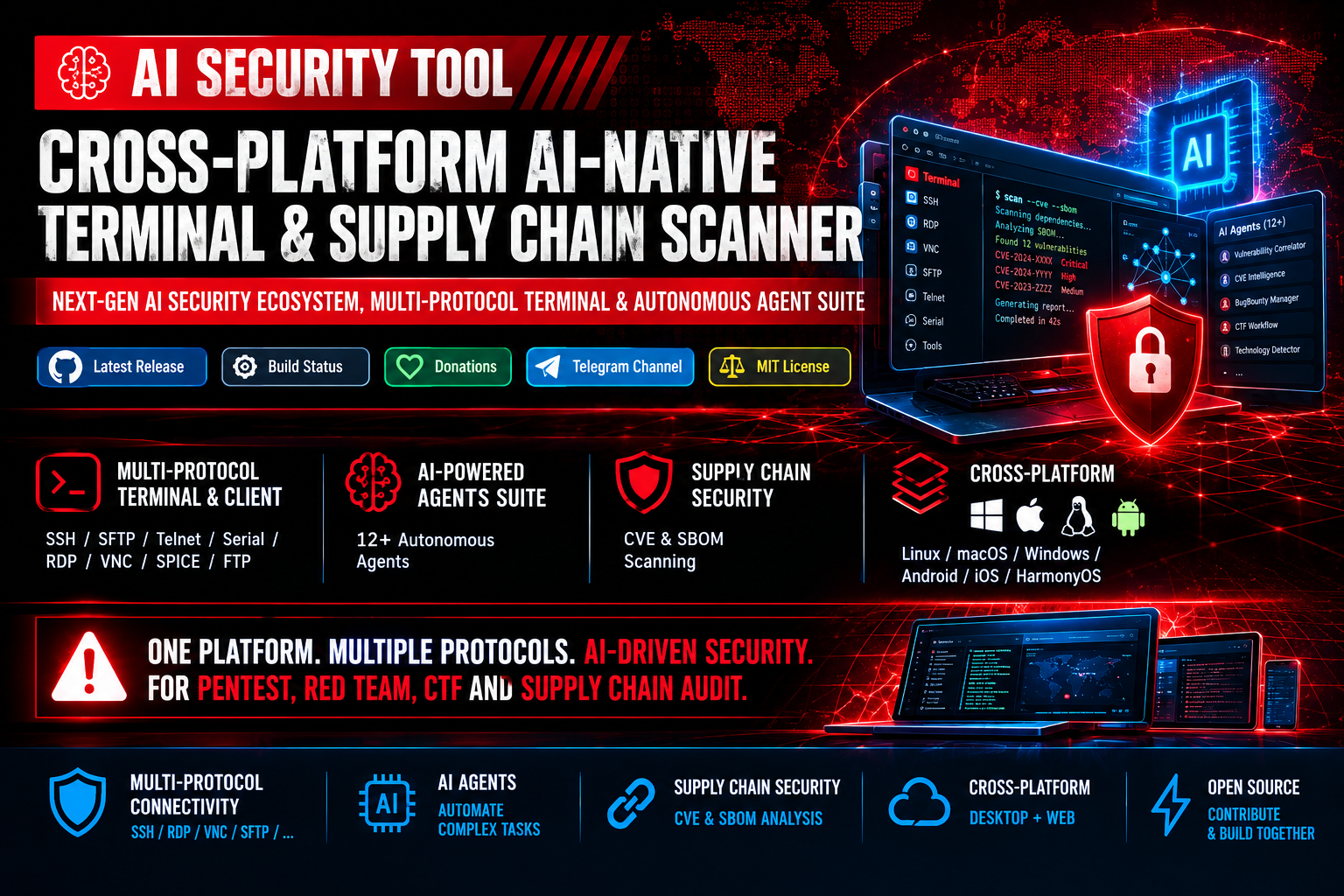
The End-State of AI Pentesting: Engineering ZeroDayEvil's Autonomous Security Terminal
1. Paradigm Shift: From Scripted Utilities to Agentic Infrastructure
Over the past decade, offensive security automation has evolved through two distinct phases: scripted primitives (Python, Bash) and modular tooling (Metasploit, Burp Suite). ZeroDayEvil signals the advent of the third wave: Agentic Infrastructure.
Rather than wrapping an LLM as a superficial chat plugin, ZeroDayEvil fuses the terminal protocol stack directly with LLM context-awareness. At the core of its "Agentic Terminal" architecture is a real-time I/O stream interceptor, powered by 12+ concurrent intelligent agents that parse terminal stdout/stderr on the fly. When you establish an SSH tunnel, the backend asynchronously cross-references executed commands against active CVE databases. This companion-style security auditing eliminates the latency inherent in traditional scanners that rely on export-then-offline-analyze workflows.
2. Architecture Comparison: Legacy Scanners vs. ZeroDayEvil
| Dimension | Legacy Security Tooling (e.g., Nessus/Nmap) | ZeroDayEvil Architecture |
|---|---|---|
| Interaction Model | CLI/GUI triggered, asynchronous reports | Conversational, real-time reactive streaming |
| Protocol Support | Static plugin dependencies | Protocol-level injection (SSH, RDP, VNC, Serial) |
| Vulnerability Analysis | Static signature matching | LLM semantic analysis + dynamic SBOM correlation |
| Automation Engine | Hardcoded procedural scripts | Dynamic task planning (ReAct loop framework) |
3. Deep Dive: Engineering Tradeoffs
Pros
- Multi-Protocol Adaptability: Native integration with Serial and VNC protocols elevates this tool beyond cloud-native environments, giving it a strong foothold in IoT and embedded pentesting.
- Contextual Memory: The agent retains state across terminal sessions. For instance, executing an
lsinside an active SSH stream automatically prompts the LLM to inspect neighboring configuration files for SBOM compliance. - Decoupled Architecture: The UI layer is cleanly separated from the core agent loop, enabling hot-swappable LLM backends. Developers can easily toggle between DeepSeek and OpenAI to optimize for cost-per-token or reasoning depth.
Cons
- Token Exhaustion Risks: High-throughput logging scenarios can quickly spiral out of control on token consumption unless aggressive truncation or streaming summarization policies are enforced.
- Trust Boundaries & Safety Limits: Autonomous command execution introduces high-blast-radius failure modes. Current iterations lack a robust human-in-the-loop (HITL) circuit breaker for destructive payloads.
- Environmental Friction: While advertised as cross-platform, the Windows RDP protocol encapsulation requires heavy driver dependencies and non-trivial configuration overhead.
4. Quickstart Guide: Installation & Automated Auditing
1. Environment Setup
Ensure Node.js is installed, then pull and bootstrap the repository via npm:
git clone https://github.com/ZeroDayEvil/ai-security-tool
cd ai-security-tool
npm install
2. Configure the LLM Backend
Populate your .env file with the required credentials. To optimize operational costs, DeepSeek is recommended as the primary provider:
LLM_PROVIDER=deepseek
LLM_API_KEY=sk-your-key-here
LLM_MODEL=deepseek-chat
REASONING_ENABLED=true
3. Initialize Security Monitoring
Spin up the core binary and attach the real-time listener to your terminal session:
# Launch the agentic terminal audit mode
./ai-term --audit-level=high --sbom-scan=on
4. Advanced: Authoring Custom Agents
ZeroDayEvil supports declarative security policies via .yaml configurations. Drop custom rules into the /agents directory to target specific application logic—such as detecting unauthenticated Redis instances:
name: Redis-Audit-Agent
trigger: "redis-cli"
action: "check-auth-and-config"
threshold: 0.8
5. Principal Architect's Recommendations
ZeroDayEvil is scaling rapidly, tracking massive velocity in early community traction. Its core value proposition lies in closing the DevSecOps feedback loop via ambient AI integration.
When deploying to production environments, strictly enforce Manual Approval modes for any automated execution pipelines. Treat the framework as a force multiplier for human decision-making rather than a fully autonomous black-box operator. Keep a close watch on roadmap updates regarding native local model runtimes (Ollama/LLaMA 3)—air-gapped local inference will be the ultimate gating factor for enterprise intranet adoption.