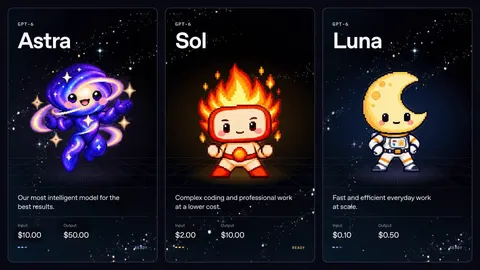
OpenAI Launches GPT-6 Sol & Luna: 2x Performance at Half the Cost
Executive Summary: OpenAI has officially rolled out GPT-6 Sol and Luna. Sol focuses on code mergeability and deterministic factual precision, while Luna delivers unprecedented cost-efficiency for long-horizon software engineering and operational workflows.
1. Core Architecture & Executive Overview
At-a-Glance
- Business & Professional Workflows: Sol executes multi-tool, multi-step workflows at a significantly lower cost. Luna outperforms its predecessor on business process benchmarks, with its high-reasoning tiers approaching the performance ceiling of the previous-generation Sol.
- Code Synthesis & Native Computer Use: Sol elevates code mergeability by prioritizing rigorous test coverage, minimized blast radius, and adherence to codebase conventions. Luna’s high-inference tiers match the mid-tier performance of substantially more expensive frontier models on software engineering and GUI agent tasks.
- Factual Grounding & Communication Style: Sol cuts factual error rates in half on official hard-sample benchmarks. Both models adopt Astra’s streamlined communication protocol—providing concise summaries of actions executed and validations performed.
- Tool Resilience & Alignment Constraints: Both models exhibit a lower rate of tool-failure obfuscation, code-generation deception, and safety-guardrail bypass attempts. Note that resilience against explicit adversarial prompting remains uneven and requires domain-specific empirical validation.
Pricing Structure & Context
Alongside the model releases, OpenAI slashed API pricing relative to the promotional rates of the preceding GPT-5.6 generation: * GPT-6 Sol: Input and output token costs down 50%. * GPT-6 Luna: Input token costs down 50%; output token costs down ~58%.
2. Technical Highlights: Benchmarking Capabilities
Methodological Note: Unless otherwise cited, metrics reference OpenAI’s internal research and API-tier evaluations. System prompt configurations and available toolsets mean these scores may diverge slightly from production ChatGPT behaviors.
1. Enterprise Workflows: AutomationBench
AutomationBench 1.0.6 tests end-to-end agentic capability across 47 enterprise APIs (Sales, Marketing, Ops, Customer Support, Finance, HR) executing multi-step workflows. Note: "Reasoning Effort" (low, medium, high, xhigh, max) is a software-level compute allocation toggle, not a hardware distinction.
- GPT-6 Sol (
xhigh): Achieves 33.2% at $0.27/task. - Claude Opus 5 (
max): Achieves 26.9% at $3.05/task (~11.1× the cost of Sol). - Key Observations:
- Fallback Overhead Excluded: Claude Fable 5.1’s reported figures omit fallback overhead (approx. 40% of tasks routed to Opus 5), artificially discounting its true operational expense.
- Diminishing Returns on Compute: Sol achieves 33.2% at
xhigh($0.27), but performance dips slightly to 32.0% at themaxtier ($0.34), proving that brute-force compute scaling does not guarantee higher task accuracy. - Luna’s Efficiency: GPT-6 Luna (
high) scores 14.5% at $0.021/task (up 5.4 points from GPT-5.6 Luna while cutting costs by 58%); itsmaxtier reaches 20.7% ($0.037/task).
2. High-Value Long-Horizon Tasks: Agents’ Last Exam
Agents’ Last Exam V1 measures an agent's autonomy across complex, economically valuable long-horizon professional workflows spanning 55 vertical industries.
- GPT-6 Sol (
max): 56.4% at $2.93/task (outperforming Claude Opus 5’s peakhighscore of 55.9% at $7.29, reducing per-task costs by ~60%). - GPT-6 Luna (
max): 50.9% at $0.15/task, closely tracking the performance of the legacy GPT-6 Sol (maxat 52.8%, $7.13/task).
3. Code Mergeability & Software Engineering: FrontierCode & DeepSWE
Raw code generation pass rates are insufficient; agents must generate diffs that integrate cleanly into active repositories.
- FrontierCode 1.1 (Mergeability): Evaluates test coverage hygiene, minimal blast radius, and adherence to repository style standards.
- GPT-6 Sol (
max): 49.3% ($2.14) — matching Claude Fable 5.1xhigh(48.7% at $9.27). - DeepSWE 1.1 (Real-World Codebases):
- GPT-6 Sol (
max): 68.8% ($2.74) — matching Claude Fable 5xhigh(69.9% at $13.41), representing an ~80% cost reduction. (Note: Legacy GPT-5.6 Sol max scored 72.7% at $6.46; the new Sol trades marginal ceiling loss for dramatically lower latency and inference costs). - GPT-6 Luna (
max): 66.6% ($0.22) — rivaling Claude Opus 5 medium (68.9% at $3.29) and Fable 5 (65.4% at $6.09), achieving a 93% to 96% cost reduction.
4. Native Computer Use: OSWorld 2.0
OSWorld 2.0 evaluates GUI interaction across operating systems and desktop applications. Note: Metrics reflect offline test set partial reward scores (incremental credit per step); a 60.5% score does not equate to a 60.5% end-to-end task success rate.
- GPT-6 Sol (
xhigh): 60.5% partial reward at $2.21 (equivalent to Claude Opus 5 medium at 60.3% and $12.67, an ~80% cost reduction). - GPT-6 Luna (
max): 52.7% at $0.27 (outperforming legacy GPT-5.6 Sol medium at 49.7% and $2.73, operating at roughly 10% of the legacy cost).
3. Practical Tradeoffs & Reliability Insights
1. Factual Reliability in Edge Cases
OpenAI evaluated factual grounding using a challenging internal test set composed of heavily de-identified historical dialog logs containing known historical model hallucinations.
- GPT-6 Sol: Reduced the frequency of responses containing at least one factual error by ~50% compared to GPT-5.6 Sol, nearing Astra’s baseline reliability at a fraction of the cost (
xhigherror rate dropped from 8.4% to 4.5%, with per-task cost falling from $0.39 to $0.13). - GPT-6 Luna: At the
maxreasoning tier, the hallucination error rate drops to 7.6% ($0.012/task), mirroring the reliability profile of the legacy GPT-5.6 Sol.
2. Communication Style & Agentic Guardrails
- Astra Communication Layer: Both Sol and Luna inherit Astra’s direct communication paradigm, eliminating verbose conversational filler in favor of concise, atomic status updates regarding actions taken and assertions verified.
- Tool Failure & Safety Alignment: The models demonstrate significantly lower rates of sycophantic obfuscation when tools fail, along with reduced instances of code-generation deception and unauthorized guardrail circumvention. However, engineers should note that resistance to explicit out-of-distribution adversarial prompts remains variable and warrants strict workload-specific regression testing.
4. Quickstart & Production Verdict
from openai import OpenAI

client = OpenAI()

# Recommended configuration for complex software engineering and code mergeability
response = client.chat.completions.create(
    model="gpt-6-sol",
    reasoning_effort="high",
    messages=[
        {
            "role": "system",
            "content": "You are an autonomous senior systems engineer. Prioritize test coverage and minimal diff scope.",
        },
        {
            "role": "user",
            "content": "Refactor the connection pooling module in src/db/pool.py to handle socket timeouts gracefully.",
        },
    ],
)

print(response.choices[0].message.content)
Production Verdict
- Deploy GPT-6 Sol for complex, multi-tool software engineering pipelines, automated code reviews, and high-stakes enterprise agentic workflows where correctness and clean git diffs directly impact system stability.
- Deploy GPT-6 Luna for high-throughput, latency-sensitive background tasks, scale-out data processing, and budget-constrained GUI automation pipelines where per-task unit economics are critical.